Part 3 Erik Saties - Four Jokes that Changed the History of Art
Many of us are aware of Satie's sense of humour, few realise how well he used his wit to change the World around him
Satie gave his
autobiography acontradictory
title:Memoirs of An Amnesiac.
Memoirs of an Amnesiac
In it he tells us about his eating habits
"My
only nourishment consists of food that is white: eggs, sugar, shredded
bones, the fat of dead animals, veal, salt, coconuts, chicken cooked in
white water, moldy fruit, rice, turnips, sausages in camphor, pastry,
cheese (white varieties), cotton salad, and certain kinds of fish
(without their skin). I boil my wine and drink it cold mixed with the
juice of the Fuchsia. I have a good appetite, but never talk when eating
for fear of strangling myself."
Drawing by Satie
and he tells what was going on in his mind when he wrote music: "Everyone will tell you I am not a musician.
That is correct. From the
very beginning of my career I class myself a phonometrographer. My work
is completely phonometrical.
Take my Fils des Étoiles, or my Morceaux en forme de Poire, my En habit de Cheval or my Sarabandes
- it is evident that musical ideas played no part whatsoever in their
composition. Science is the dominating factor. Besides, I enjoy
measuring a sound much more than hearing it. With my phonometer in my
hand, I work happily and with confidence. What haven´t I weighed or
measured? I´ve done all Beethoven,
all Verdi, etc. It´s fascinating. The first time I used a phonoscope, I
examined a B flat of medium size. I can assure you that I have never
seen anything so revolting. I called in my man to show it to him.
On my phono-scales a common or garden F sharp registered 93 kilos. It came out of a fat tenor whom I also weighed"
Satie's Letters were beautiful to look at
and are sometimes ornamented with drawings
Satie's Letter to Eva
which like his music never waste a line
The notes for his sheets of music were fantastical,
His strange sparse scores, often written without bar lines
are peppered
with whimsical instructions : " Like a Nightingale with Toothache" "Light as an egg", "Open
your head" and "Work it out yourself"
Satie took a delight in giving his compositions bizarre and nonsensical names to
1912 "Véritables préludes
flasques pour un chien" Flabby Preludes for a Dog
Satie's wit beguiles us into believing he was always looking for ways to
make a joke. It is almost as if Satie was running an amusing sideshow
on top of his more serious work as a composer. There are many theories about why he did it; was it that he wanted
to detract attention away from himself or was it a way to keep himself pure?
Sometimes his wit changed history, here are four examples.
Joke Number 1: The Birth of Surrealism and the Language of Advertising
We already know that the word "surrealism" was invented by Guillaume Apollinaire to describe "The Alliance" between Satie, Picasso, Masssin and Cocteau.
Years earlier, in 1903, Satie had written one of his most popular pieces of music: Trois morceaux en forme de poire, (Three Pieces in the Shape of a Pear for piano four-hands from 1903).
In fact the music is an arrangement
cabaret melodies in seven parts, not three, .
Conductor Vladimir Golsch Mann, recalled this conversation with Satie: "Once, after we had played Morceaux en forme de poire , I asked our hero....why he gave such a title Pieces in the Shape of a Pear to this ravishing music. He answered with a twinkle in his eyes: “You do know that I visited Debussy quite often; I admire him immensely and he seems to think much of whatever talent I may have. Nevertheless, one day when I showed him a piece I had just composed he remarked, ‘Satie, you never had two greater admirers than Ravel and myself; many of your early works had an influence on our writing....You have some kind of genius, or you have genius. From time to time there is in your art a certain lack of form...’
All I did,” added Satie, “was to write Morceaux en
forme de poire. I brought them to Debussy who asked, ‘Why such a title?’
Why? Simply, mon cher ami, because you cannot criticize my Pieces in
the shape of a pear. If they are in the form of a pear they cannot be
shapeless."
Saties' friends picked up on this title as a sort of emblem for Satie's
wit. In 1913 Man Ray, when he wanted to pay homage to Satie, made this
image of a Pear against the background.
Homage to Satie by Man Ray 1913
In 1946, the surrealist painter René Magritte, who was a fan of Satie's work, used the image of fruit against clouds in one his most famous surrealist paintings Le fils de l'homme.
Le fils de l'homme 1946 Magritte
The language of Surrealism was adopted into modern advertising techniques, giving us brands like this.
this
and this
Joke Number 2: The Birth of French Impressionist Music
Satie openly stole tunes and parodied other composers music, he also liked to putting ideas from American music, Ragtime,into his compositions, but
he was also very interested in purity, especially the purity of French music. Satie became very well known for railing against the influence Wagnerianromanticism which he thought was polluting French music. He would say ”We need our own music, if possible
without sauerkraut"
Claude Debussy
He confronted Debussy with is opinions:"I
explained to Debussy .......I was in no way anti-Wagnerian, but we need our own music, if possible
without sauerkraut."
Satie suggested Debussy should draw
inspiration for a new kind of French opera from Impressionist painters such as Monet and Cezanne.
He told Debussy "There is no need for the
orchestra to grimace when a character comes on the stage......Do
the trees in the scenery grimace? What we have to do is create a
musical scenery, a musical atmosphere in which the characters move and
talk". Debussy later admitted that he used Satie's advice and this led him to write
"Pelleas et Melisande" (1902),
Mary Garden: The first Mélisande
the first opera of the French Impressionist school of music.
Pelléas et Mélisande” at the Opéra Bastille
Joke Number 3 - The Birth of Minimilism
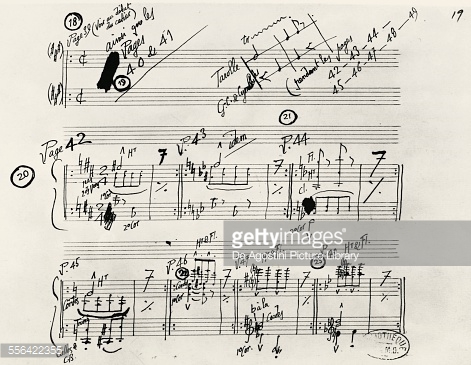
About this time he Satie wrote an interesting was piece of music called “Vexations”, it consisted of half a sheet
of music that was never published in Satie's lifetime.
Vexations original Score
The music is a parody of what in Wagnerian music is known as the "unendliche Melodie" (unending melody).
Written above the music Satie directs the reader that: "In order to play the theme 840 times in succession, it would be advisable to prepare oneself beforehand, and in the deepest silence and serious immobility". Even before repetition, the piano line is unnerving: mild but menacing, exquisite but skewed, modest but exacting.
In 1963 John Cage arranged the first performance which took 18 hours and forty minutes, many times longer than Die Meistersinger, Wagnerian longest opera. John Cage said that Satie was responsible for the “one new idea since Beethoven” the use of controlled duration as a structural element.
The principles of John Cage in the 1960s and the Minimalistic music of Philip Glass of the 1990s had their origins in Satie's Humour.
Joke Number 4 The Birth of Background Music
In 1920 Satie introduced a concert featuring the works of Les Six (as the six young musicians that he worked with came to be called).
Groupe des Six Jacques-Émile Blanche
(Germaine Tailleferre, Darius Milhaud, Arthur Honegger, Louis Durey; at right: Georges Auric, Francis Poulenc and Jean Cocteau.)
It was played during the first intermission and the audience was told, “We urgently beg you not to attach any importance to it and to act during intermission as if the music did not exist...it hopes to contribute to life the way a casual conversation does, or a picture in a gallery, or a chair in which one is or is not seated.” Despite this announcement, when the music started people returned to their seats.
Satie told everyone to keep talking “Whatever you do, don’t listen!” Satie called this music " musique d’ameublement" "furniture music". Satie and his Dadaist friends had invented the concept of "background music"
His Legacy
Satie was very influential during his lifetime, but whenever success came his way he would shed another skin and reinvented himself. After Satie died in 1925 he left a legacy of over 150 solo piano pieces, 14 songs, 6 stage works, Mass for voices and organ, a cantata and a new musical traditions
that were followed by Debussy, Ravel, Stravinsky and Poulenc.
At the end of his life a fellow composer, Darius Milhaud wrote, "Satie was our mascot. The
purity of his art, his horror of all concessions, his contempt for
money, and his ruthless attitude toward the critics were a marvellous
example for us all."
This is the legacy we have come here to celebrate tonight.
ERIK SATIE’S BALLET PARADE: AN ARRANGEMENT FOR WOODWIND QUINTET AND PERCUSSION WITH HISTORICAL SUMMARY Tracy A. Doyle http://etd.lsu.edu/docs/available/etd-07112005-201540/unrestricted/Doyle_dis.pdf
http://www.findagrave.com/cgi-bin/fg.cgi?page=gr&GRid=4404
Rodolphe Salis, the impresario-owner of Le Chat Noir, died in 1897. The subversive culture of his Cabaret club had contributed to the development of the pleasure seeking culture of La Belle Époque. Folies Bergère.
and Le Moulin Rouge where Jane Avril and the Can Can girls danced were all the rage.
This spirit was immortalised in the pictures of Toulouse-Lautrec
Satie 1891 painted by Ramon Casas
Satie, coming into a small inheritance, had blown all his money on a collection of identical suites and was now affectionately known as "the Velvet Gentleman". Even though he lived in poverty he met everyone as he made toured the Cabaret bars and private salons accompanying
singers and writing songs, his most prolific collaboration during these
years was with the philosopher-turned-lyricist Vincent Hyspa.
Vincent Hyspa 1906
The high life of La Belle Époque was not enough for Satie, he craved the same recognition given to his close friend Debussy, a kindred spirit and close friend who had achieved great success in the world of art music. Satie was left behind, only appreciated as a minor composer of sublime and beautiful cabaret
and salon songs.
In these years Satie’s behaviour became more eccentric, he even started a religion called the "Metropolitan Art Church of Jesus the Conductor" which had services in his cupboard. As its only member,
in the role of "Parcier et Maître de Chapelle", he composed a Mass for the Poor.
Satie blamed his lack of success on his laziness as a student and in 1905, at the age of forty, he set to put this right by enrolling in the Schola Cantorum where he became "an assiduous student". His teachers were reluctant to teach him, saying he was already a very knowledgeable and gifted musician, but Satie refused to be put off.
In 1911, Satie’s luck began to change, this was made possible by Debussy
and Ravel, both of whom performed his works for a larger and more elite
audience than Satie could have arranged on his own. By now Satie had changed his dress to that of a civil servant with a bowler hat and umbrella. On one occasion Darius Milhoud met him in the street walking through driving rain with an umbrella folded under his arm. Asked "why are you not using your umbrella" Satie replied "Mon cher, my umbrella is much to valuable to get wet".
Igor Stravinsky drawn by Picasso
The rediscovery of Satie by the public created opportunities in the final decade of his life. He came into contact with Igor Stravinsky who thought Satie was "the strangest man I have ever met". Stravinsky had become famous for his part in the "successful scandal" surrounding the The Ballet Russe's production of The Rite of Spring
Jean Cocteau
Jean Cocteau introduced Satie to Diaghilev, Picasso and the choreographer Massine with the promise that together they could create another "successful scandal"
Diaghilev
Cocteau and Diaghilev
Picasso 1923
Massine, Leonide (1895-1979) by Leon Bakst
The first of these collaborations was "Parade", the cubist ballet production.
Parade, which brought together Erik Satie’s first orchestral score, Pablo
Picasso’s first stage décor and Massine’s first cubist choreography, challenged the presumptions of Parisian society which was being devastated by the
ravages of the first world war.
Pablo Picasso - Artist salon at rue La Boétie - Jean Cocteau, Olga, Erik Satie, Clive Bell (1919)
Picasso's red curtain for Parade
In the programme notes, written by Guillaume Appolonaire, Satie's score which included noise making instruments; a typewriter, a pistol, splashy noises made with sponges and a 'bouteillophone' ('bottlephone'- made of milk bottles) is described as "astonishingly expressive music, so clear and simple that it seems to reflect the marvelously lucid spirit of France.". Appollonaire's programme notes, which used the word surrealist for the first time in history, later became the manifesto of an art movement called "l’esprit nouveau" (The New Spirit).
the Conjurer, 'Parade' 1917
Parade and Satie's behaviour afterwards, became the "successful scandal" they had planned making Satie the darling of the rich bohemian salons and avant-garde art movements.
Satie, Massine and Picasso collaborated again on other ballets, Mercure "The Painters Ballet" which was commissioned by the Soirées de Paris Stage Company and performed at the Théâtre de la Cigale in Paris on June 15, 1924
Count Étienne de Beaumont
Picasso's set design for Mecure with music by Satie
Picasso's set for Mecure
Satie also wrote the scores for the Avant-garde Ballets Suédois, which made its home at the Théâtre des Champs-Elysées in Paris from 1920 to 1924.
Ballet Suedois
"Relâche," was a Dadaist exercise
that united the zany talents of Erik Satie and painter Francis Picabia.
Relâche
Ballets Suédois went out of there way to be scandalous and openly offensive to their audiences. The ballet is now best remembered for the of the wacky 20-minute film called
"Entr'acte" that the young René Clair made to be shown before the ballet started. The films starts with Satie and Clair firing a canon at the audience and has the first synchronous, shot-by-shot film score in history.
René Clair and Satie during filming of "Entr'acte"
Entr'acte
Satie had been unwell while Relâche was being made and he died a few months later, aged 59, of Cirrhosis of the liver .
After his death Darius Milhaud, a fellow composer, told us what he found when he went to clear his possessions from a room.
"A narrow corridor with a washbasin in it, led to the bedroom into which Satie had never allowed anyone, not even his concierge to penetrate. It was with a feeling akin to awe that we approached it now. What a shock on opening the door! It seemed impossible that Satie lived in such poverty. The man, whose faultlessly clean and correct dress made him look rather like a model civil servant, had
literally nothing worth a shilling to his name: a wretched bed, a table
covered with the most unlikely objects, one chair and a half-empty
wardrobe in which there were a dozen old-fashioned corduroy suits, brand
new and almost identical.....a broken-down piano with its pedals tied up with string.....in an old cigar box more than four thousand little pieces of paper on which he had made curious drawings and written extravagant inscriptions...."Satie had 84 identical handkerchiefs, and dozens of hats and umbrellas