The Intelligence of Grass
Part One
The Making of Intelligence

The Church of La Sainte Chapelle
If you ever visit Paris you should take a trip to the light-filled church of La Sainte Chapelle which is a marvel of the flamboyant (Rayonnant) style of Gothic architecture. |
| La Sainte-Chapelle in Paris |
 | ||
| La Sainte-Chapelle in Paris photo Francois Didier |
When you stand in the centre of the church you will experience a sense height, weightlessness and colour. The Master Builder in charge of the construction probably worked from simple plans and personal experience with a team that would have been made up of illiterate carpenters, stone masons, craftspeople and their apprentices. It is extraordinary to think the church. which was completed in 1248, is held up by the downward forces of gravity. The masons who built this church knew how to control the thrust and counter thrust of the gravitational forces passing through the stones of the building, with this knowledge they channelled the downward thrust of the huge weight of the stone vaulted roof on a journey round the curved stone ribs of the ceiling arches to the heads of slim elegant pillars. The carriage of the weight at the top of the pillars is supported by external flying buttresses that keep the pillars from splaying outwards.

This fragile church has stood in elegant stability for nearly 800 years ago. The irony is that the lively illusion of lift we admire so much is held in place by the huge compression from the roof on the inert stones walls below.
Christianity was not alone in believing light has spiritual meaning, but the development of Christian theology of light is an eccentric and interesting story. In the old testament God reveals himself to Moses as a burning bush but it is in the New Testament that the notion that "God is Light" becomes of central importance to Christianity. In the Gospel according to St John Jesus tells us that "I am the light of the world. Whoever follows me will never walk in darkness, but will have the light of life." John 8:12. American Standard Bible
No amount of persecution stopped the spread of Christianity which became popular amongst the Roman Soldiers, and in 312 CE Emperor Constantine I seized control of the Roman Empire at the Battle of Milvian Bridge under the Christian banner. Constantine was an ambitious and pragmatic man who transformed Christianity from being a marginalised, disparate and sometimes fractious underground sect into one of the official religions of Empire.
The Churches new status as an official religion of State enabled Christians to move out from their dark basements to take over the old temples of Mithras. Some of today's churches, like the Basilica of San Clement (rebuilt 1100), still have foundations that sit on the remains of Mithric Temples.
A short time after Constantine's death there lived a scholarly monk called Jerome (347-420)
The natural light coming through the windows of the Roman churches delighted Jerome. He even mentions knowing the Church of St Clements on which the Basilica of San Clement (above) was later built. We can sense St Jeromes trauma when he wrote " Often I would find myself entering those crypts, deep dug in the earth, with the walls on either side lined with the bodies of the dead....Here and there the light, not entering the windows, but filtering down through shafts, relieved the horror of the darkness...black night closed around and there came to mind the line of Vergil " Horror ubique animos, simul ipsa silenta terrent" (everywhere horror seizes the soul and the very silence is dreadful)

This fragile church has stood in elegant stability for nearly 800 years ago. The irony is that the lively illusion of lift we admire so much is held in place by the huge compression from the roof on the inert stones walls below.
Gothic Architecture and the Cult of the Sun
Gothic master builders honed their knowledge and designs over centuries. Their building techniques were tested by trial and error that was passed down the generations, each new generation being driven by the desire of medieval Christians to fill their churches with ever more natural light.Christianity was not alone in believing light has spiritual meaning, but the development of Christian theology of light is an eccentric and interesting story. In the old testament God reveals himself to Moses as a burning bush but it is in the New Testament that the notion that "God is Light" becomes of central importance to Christianity. In the Gospel according to St John Jesus tells us that "I am the light of the world. Whoever follows me will never walk in darkness, but will have the light of life." John 8:12. American Standard Bible
From the start the Roman and Jewish authorities saw the beliefs of the early church as subversive and threatening. When Pontius Pilate tried to quench the flames of belief in early Christians by crucifying Jesus he only succeeded in driving his followers into the darkness of windowless basement churches where the early Christian communities worshipped "the light of the world". Just 64 years after Jesus' death the Christians were being blamed by Nero for the burning of Rome.
 | |
| Chapel of Saint Ananias, Damascus, Syria, 1st century |
 |
| The spread of Christianity across the Roman Empire |
The Churches new status as an official religion of State enabled Christians to move out from their dark basements to take over the old temples of Mithras. Some of today's churches, like the Basilica of San Clement (rebuilt 1100), still have foundations that sit on the remains of Mithric Temples.
 |
| The Basilica of San Clement, Rome (rebuilt in 1100) |
 |
| Remains of Mithric temple under St Clements |
A short time after Constantine's death there lived a scholarly monk called Jerome (347-420)
 | ||
| St Jerome, Painting by Niccolò Antonio Colantonio. |
(St Jerome translated the bible from Hebrew into Latin)
The natural light coming through the windows of the Roman churches delighted Jerome. He even mentions knowing the Church of St Clements on which the Basilica of San Clement (above) was later built. We can sense St Jeromes trauma when he wrote " Often I would find myself entering those crypts, deep dug in the earth, with the walls on either side lined with the bodies of the dead....Here and there the light, not entering the windows, but filtering down through shafts, relieved the horror of the darkness...black night closed around and there came to mind the line of Vergil " Horror ubique animos, simul ipsa silenta terrent" (everywhere horror seizes the soul and the very silence is dreadful)
The new buildings inherited and built for the early church were Romanesque, an architectural era that spans from the decline of the Roman empire to the beginnings of the medieval Gothic traditions. Romanesque churches have rounded Roman (Norman) arches similar to the style the Romans used for their aqueducts. The churches have tall narrow naves, stocky pillars and thick walls that are supported from the outside by substantial external buttresses. The narrow distances between pillars leave limited space for windows through which the natural light of God arrives and floods the place of worship.
 |
| Basilica Saint Sernin (Toulouse 12th Century) |
The Evolution of Gothic Architecture
We know we will never squash a stone
but a sharp hit with a mallet on the same slab will crack the stone

this is why a slab of stone used as a beam for a bridge will break under the quite light thumping of traffic.

In ancient Greece they placed short and stubby lintels on top of unsquashable tall pillars. The builders knew that it would be dangerous to have longer lintels, so the space between the pillars was always quite narrow.
 |
| Remains of Temple of Olympian Zeus Athens |
The Roman genius was to realise that stone arches can be strung together in lines to create long, strong, free-standing load bearing bridges that would not crack under heavy traffic and could be used as aqueducts across wide ravines
Arches arranged in a line are load-bearing but when the same weight is put on the centre of a free standing arch the lateral forces push the heads of the supporting pillars apart!

Free standing arches are only load bearing when the heads of the pillars are prevented from splaying apart with buttresses. Arched entrances in walls can be higher and wider than doors with lintels which is why the arch became a symbol of imperial majesty through which victorious armies marched after returning from their campaigns abroad.

 |
| Aqueduct Near Nerja, Spain |
Arches arranged in a line are load-bearing but when the same weight is put on the centre of a free standing arch the lateral forces push the heads of the supporting pillars apart!

Free standing arches are only load bearing when the heads of the pillars are prevented from splaying apart with buttresses. Arched entrances in walls can be higher and wider than doors with lintels which is why the arch became a symbol of imperial majesty through which victorious armies marched after returning from their campaigns abroad.

The Romans built many free-standing Triumphal Arches, these were always built between wide buttresses on each side. The is a typical Romans arch with rounded top and side doors.
 |
| Ancient_Roman_triumphal_arch_of_Medinaceli-Spain |
Gothic Arches and Flying Buttress
A novelty of Gothic architecture was the development of pointed arches; pointed arches have less lateral thrust at the heads of the supporting pillars.Gothic arches could be made taller and wider than rounded arches, however the tops of the pillars still needed buttressing. The reduced lateral forces were absorbed through curved half arches called flying buttresses. The ceilings of late Gothic Cathedrals are a web of intersecting stone arches, called ribs, which provided the structural strength. In-between the ribs they used lighter thinner stone. The lighter the roofs the broader the ceiling arches could be; the nave of York minster is 30 metres wide
King's College Chapel, Cambridge, is amongst the last of the late Gothic churches built The wall space between the pillars is filled with filigree stonework that support huge stained glass windows. During the daytime services "the true light of God" floods into the nave and over the congregation, St Jerome would have loved it.
 |
| King's College Chapel Cambridge during the day- no need for artificial light! |
Gothic architecture is a good example of how technological evolution responds to narrowly specified cultural demands. Late Gothic churches, such as Kings College Chapel in Cambridge, represents a paradigm of technical know-how that had been gathered
and passed down by generations of builders. The enduring stability of their elaborate stone piling techniques was achieved by using the gravity of a few keystones to lock every last stone permanently into place. Whenever we look at evolution, both technological and Darwinian, we come
across this balancing act between refined fragile structures that are as delicate as a house of cards and the strength factor, where environmental factors threatens the stability of the house of cards. Every evolutionary process meets a point where further evolution is constrained by the harshness of the environment, in a world without wind or subsidence the Gothic architects might have felt confident to build even more fragile cathedrals.
Kings College is a brittle, light filled structure that would be too fragile to survive a single Japanese earthquake, in contrast the Buddhist pagoda at Horyu-ji, Nara, which is the oldest wooden building in the world, was evolved to remain stable in the harsher environmental conditions of an earthquake zone.
The ancient Heian culture that made Horyu-ji constructed their pagodas like Christmas Trees. The trunk of the buildings are lifted above the ground and the surrounding rooms are attached to the central pole with flexible pegs. When an earthquake strikes the trunk of the building is isolated from the full impact of the movement of the ground and the attached rooms on the outside of the central mast go up and down a bit like the waving branches of a tree. This pagoda, which is is higher than Kings College Chapel and nearly twice as old, demonstrates another paradigm of delicacy and stability that was evolved to fit into a different cultural and environmental narrative.
Both Kings College and Horyu-ji are huge ancient objects. By and large technological evolution, as we know it today, is a process of continuous refinement and the machines we make have a tendency to become more efficient, smaller and often so delicate that they can only exist in protected artificial environments. This evolutionary transition is evident in the evolution of one of our oldest inventions; timepieces. Amongst the most ancient surviving timepieces are massive astrological calenders like the circle of stones at Stonehenge that measured the passing of the solstices.
Ancient Bronze age cultures also used water clocks for measuring shorter units of time, the simplest were leaking bowls called by the Greeks clepsydra (κλεψύδρα, "water thieves"). The simplest clepsydra were bowls which had a single small hole cut in their base. The Romans and Greeks used leaking bowls like these for limiting the length of speeches in their Senates or measuring how much time clients had bought at a brothel.
There are stories of ancient water clocks that were elaborate Heath Robertson contraptions, amongst the most amusing was an alarm clock used by Plato (428 - 347 BC) to wake his students. Plato's alarm clock was an empty columnar vessel inside which was placed a wooden cradle containing lead balls, before they went to sleep the students turned on a tap that let water flow into the vessel at a constant rate. As the hours passed the balls were lifted by steadily rising water to the top of the column where after the allotted time they spilled over the edge of the vessel and fell with an enormous clang on to copper platter.
About a hundred years later, in 250 BC, a Greek called Ctesibius of Alexandria invented an elaborate water clock with cogs that were driven by a siphon escapement. This clock may have been the first 24 hour clock with a dial and pointer.
For the next 1500 years Ctesibius' clepsydra remained the most accurate way to measure time, his invention spread to China where Zong's water clock was built in 1088. Zong's water clock was a 33 foot tower with escapements that wrung a bell every quarter-hour.
In Europe water clocks gradually were gradually replaced with public church tower clocks that were powered with weights. The Salisbury Cathedral clock of 1386 was advanced for its era, it struck a bell on the hour but had no clock face.
But water clocks were still more accurate and in use in 1600 when Galileo was using them for his
experiments, as an old man Galileo suggested a swinging weight would make a more accurate time regulator than water (1642). Galileo's idea was developed after his death by Christiaan Huygens who in 1656 made the worlds first pendulum clock.
The invention of pendulums was followed by a period of rapidly improving efficiency, refinement and miniaturisation. One of the greatest geniuses of clock making, John Harrison (1693 - 1776), spent most of his early life trying to make sea clocks.
As time went by he realised that small watches were often more accurate than his larger clocks and the second half of his life was spent was inventing new finer escapement mechanisms for pocket sized chronometers, like this elaborate and beautiful. grasshopper escapement. Such miniaturisation delicacy had to be housed in protective casings
Kings College is a brittle, light filled structure that would be too fragile to survive a single Japanese earthquake, in contrast the Buddhist pagoda at Horyu-ji, Nara, which is the oldest wooden building in the world, was evolved to remain stable in the harsher environmental conditions of an earthquake zone.
 |
| The Horyu-ji is 34.5m tall, 4 m taller than Kings College Chapel |
The ancient Heian culture that made Horyu-ji constructed their pagodas like Christmas Trees. The trunk of the buildings are lifted above the ground and the surrounding rooms are attached to the central pole with flexible pegs. When an earthquake strikes the trunk of the building is isolated from the full impact of the movement of the ground and the attached rooms on the outside of the central mast go up and down a bit like the waving branches of a tree. This pagoda, which is is higher than Kings College Chapel and nearly twice as old, demonstrates another paradigm of delicacy and stability that was evolved to fit into a different cultural and environmental narrative.
 |
| Pagoda at Horyu-ji Temple |
Both Kings College and Horyu-ji are huge ancient objects. By and large technological evolution, as we know it today, is a process of continuous refinement and the machines we make have a tendency to become more efficient, smaller and often so delicate that they can only exist in protected artificial environments. This evolutionary transition is evident in the evolution of one of our oldest inventions; timepieces. Amongst the most ancient surviving timepieces are massive astrological calenders like the circle of stones at Stonehenge that measured the passing of the solstices.
 |
3D rendering of Stonehenge by Joseph Lertola
|
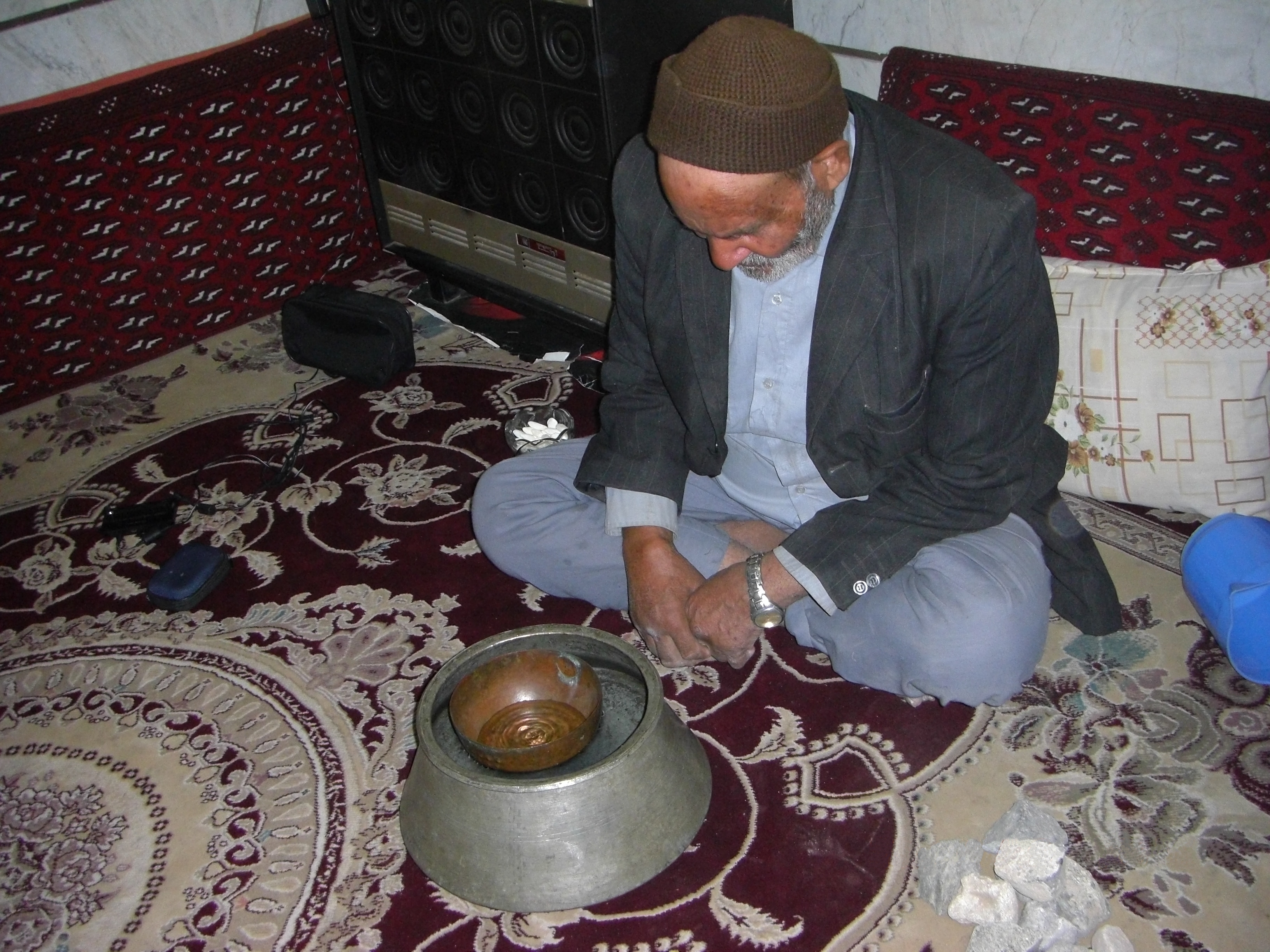 |
| A Persian Clepsydra (Wikicommons) |
About a hundred years later, in 250 BC, a Greek called Ctesibius of Alexandria invented an elaborate water clock with cogs that were driven by a siphon escapement. This clock may have been the first 24 hour clock with a dial and pointer.
 |
| Su Zongs water clock 1088 was about 33 feet high |
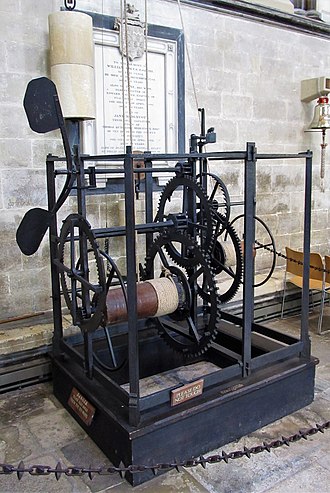 |
| The Salisbury Clock 1386 |
 |
| Huygens pendulum clock 1656 |
The invention of pendulums was followed by a period of rapidly improving efficiency, refinement and miniaturisation. One of the greatest geniuses of clock making, John Harrison (1693 - 1776), spent most of his early life trying to make sea clocks.
 |
| Harrison's first sea clock |

his last sea watch was accurate to within a third of a second a day and was not affected by the motion of waves.
 |
| Harrison's Chronometer H5, Science Museum, London |
Harrison's fragile mechanisms are not as delicate or accurate as atomic clocks which measure time inside a microwave-filled cavity that first cools the atoms to near absolute zero temperature by slowing them with lasers. FOCS 1, a continuous cold caesium fountain atomic clock in Switzerland, started operating in 2004 at an uncertainty of one second in 30 million years. We might refer to the stable zone inside FOCS 1 as a habitable zone for atomic timepieces.

The products of Darwinian evolution also evolve to fit within habitable zones. All of life as we know it lives in a zone around the sun that is neither too hot or too cold for the delicate structures of life, it is often laughingly called the Goldilocks Zone. Darwinian Evolutionists call zones in which species live niches.
 |
| The Goldilocks Zone http://planetary-science.org |
 |
| “‘The Machine,’ A.D. 1640–1750.” From Sir Walter Gilbey’s Early Carriages and Roads |
When we look back at the stage coach of the 17th century we find that a 65 mile journey from London to Cambridge was an arduous two day bone-shaking trauma along the rutted tracks of drovers lanes, by the 1830s, through the miracle of human ingenuity, the tracks were improved and with some modest improvements in the technology of the carriages they were making the same journey in more comfort in one day .

Over the next two hundred years our roads have developed into smoothed tarmacked runways that provide a Goldilocks Zone along which the delicate machinery of modern cars can glide at constant speeds of 80 mph, 16 times faster than the 17th century horse drawn coaches and in a lot more comfort. Inter-locking co-evolution between protective environments and the delicate machinery of life is a common theme in Darwinian evolution. In our daily lives we are familiar that our body temperature is constant, we also know that when our temperature rises by a degree or two we begin feel ill, if it rises by 5 degrees the machinery of life breaks down and we die. This is because our metabolism has evolved to run smoothly within in a narrow and stable sweet zone. Asking our metabolism to run outside the narrow parameters of the sweet zone (which are between 96.5 - 98 c) is a bit like trying to drive a sports car across a waterlogged field or an atomic clock at room temperatures.
When we look at the evolving technological achievements of our species, it looks as if our unique ability to apply science and reason surpasses the abilities of Darwinian evolution. It has taken nature 3.5 billion years to produce flying birds, the mammalian eye and brains. In stark contrast it has taken a mere 5,000 years ago for humans to go from inventing the cart wheel in Sumeria to creating civilisations that have learnt to build Gothic cathedrals, aeroplanes, cameras and computers.
 |
| Cart wheels were invented about 5000 years ago Onager-drawn cart on the Sumerian 2,500BC (Image Wikipedia) |
It is an astonishing fact that our technological evolution has happened at a speed five hundred thousand times faster than Nature. Anyone can see how our buildings are higher and have better air-conditioning than the biggest termite mounds; our aeroplanes and space ships fly faster, higher and further than any bird; our cameras see wider spectrums of light than any eye and our computers solve maths equations at speeds far faster than the brains of our Nobel prize winners. We can even fly to the moon. History seems to demonstrate that we humans are far better at evolving machines that will overcome physical challenges than Darwinian natural selection. Human reason is clever, Nature is dumb, Nature sucks!
As technological evolution gathers pace so does our understanding of how the natural world does things. New cognitive sciences lets us take a cold rational look into our own brains and see how consciousness and intelligences are tied to the purely physical activities of brain structures; glial cells, nerve cells, hormone releasing glands, synapses, dendrites, myolin sheaths and neurotransmitters. Scientist who work in this field begin to view the brain as a physical "machine" that perhaps contains a mysterious quality that we call spirit or conciousness. Inevitably they ask themselves "if we are better than nature at making machines then surely we can simulate neural networks with our computers, and eventually we will re-create intelligence?". Hand in hand with our desire to know about how nature works comes the hubristic niggling belief that we are nearing God's ability to create machines with spirit.
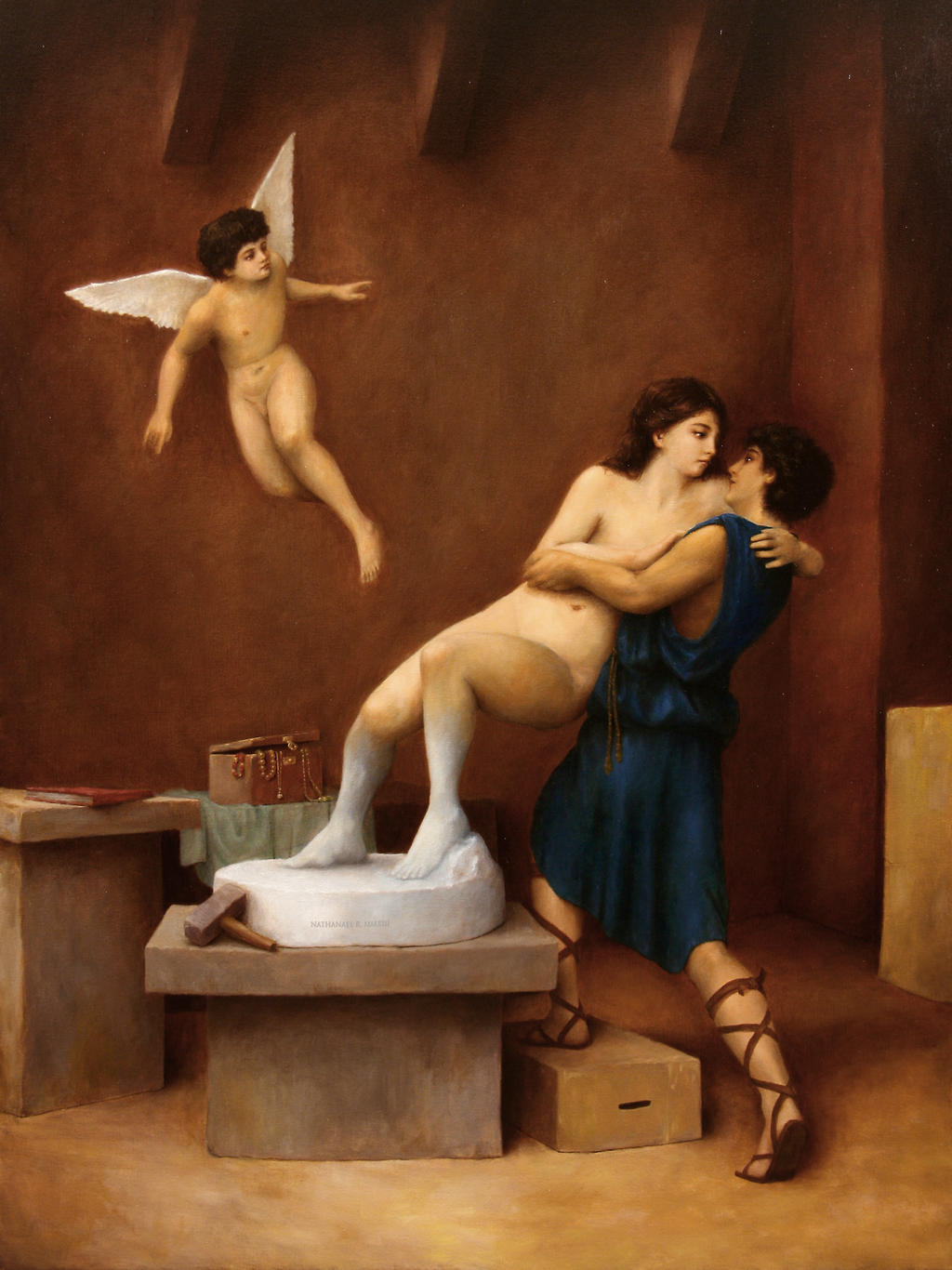 |
| Pygmalion & Galatea by Lasarasu |
These fantasies are not new, our ancient myths speak of our making creations like Galatea and Frankenstein that come to life, these fantasies continue in popular culture in TV series like "Humans" that feature androids that seek to acquire souls like those given to us by Nature. It was almost inevitable that the development of computers was accompanied by the genesis of a challenge to test machines for (intelligent) thought. In 1950, over 65 years ago, Alan Turing, who is most famous for his pioneering work with designing and developing code breaking computers at Bletchley Park during World War II, set the Turing test.
 |
| Alan Turing |
The Turing test is supposed to test whether machines can exhibit intelligent behaviour that is indistinguishable from that of a human. Turing supposed that when a human is unable to distinguish between answers given by a machine and answers given by a human, then the machine has become intelligent.
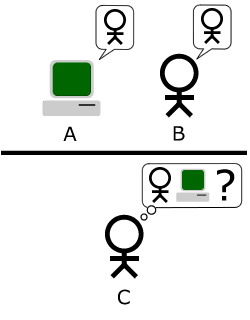 |
| The Turing Test (Wikipedia) |
Turing's test was conceived during period when psychology was dominated by various narrow-minded schools of "Behaviourism". Behaviourists believed that all science must be testable, otherwise it was not science, they were particularly impressed by Pavlov's famous demonstration that dogs could be trained to salivate to the sound of a bell. Behaviourists aggressively rejected the intervention of nebulous unmeasurable influences into their studies and models of the mind. During Turing's day the Behaviourists sidelined discussions on consciousness by introducing a theory of "epi-phenomenology". Epiphenomenology explained away our consciousness and feelings as being a mysterious and irrelevant by-product of the mechanical processes of the brain that had no useful purpose. Using this belief behaviourists effectively made the study of consciousness, feelings and even emotions were taboo subjects within academic circles. Turing's test seems to fall into the trap of assuming that consciousness was either irrelevant to thought or would spontaneously ignite when the mechanics of thought passed a certain threshold or were replicated in a correct manner. His test is almost a variant of the commonly quoted aphorism that if it looks like a duck, walks like a duck and quacks like a duck then it probably is a duck? If you cut the duck in half and find out its brain is made of wire and transistors you can still classify it as a duck because the wires inside the duck replicate the mechanics of the mind, so for the Behaviourists of Turings day the fact that the duck's brain was not made of flesh and bones did not preclude the duck from having consciousness and intelligence.
This attitude still prevails in the style of our reporting on advances in Artificial Intelligences, usually comparing them with feats of the human mind.. In 1997 a computer called Big Blue beat Gary Kasparov at chess, this year AI passed a new milestone when a machine called Libratus beat four of the world’s best poker players in a gruelling 20-day tournament. (Poker is harder than chess because each player players don’t get to see each other’s hands and have to correctly interpret misleading information in order to win). At the populist end of are our dumb cars and phones that have "smart" technology to talk with us and answer questions, robots that have been developed as companions for the elderly and a virtual assistant called Alexa that has received 250,000 marriage proposals. Recent AI machines often do not come out of the box fully programmed, they need to be taught and learn their jobs. For many people computers are already passing the Turing test and are intelligent, but for others virtual intelligences are examples of the computer industries becoming better and better at creating fraudulent illusions of consciousness in machines.
There is a well used thought experiment called "the Chinese Room Argument"

The trick behind Artificial Intelligence (AI) is exposed in Jeff Hawkins' book On Intelligence (2004) where he tells us about his thought experiment: "....a typical neurone can reset itself in about 5 ms, a modern (2004) computer do one billion operations in a second"...... "A human can perform a significant task in much less than a second. For example, I could show you a photograph of a cat and ask you to determine if there is a cat in the image".......(Not a bear?)......"This task is difficult or impossible for a computer to perform today (2004), yet a human can do it in reliably in half a second or less. But neurones are slow, so in that half second, the information entering your brain can only traverse a chain of one hundred neurones long. That is, the brain "Computes " solutions to problems like this in one hundred steps or fewer, regardless of how many total neurones might be involved.......a digital computer attempting to solve the same problem would take billions of steps. One hundred computer instructions are barely enough to move a single character on the computers display". Big Blue, Libratus and Alexa achieve "intelligence" by following billions of instructions that would take a human brain years to compute. AI, as we know it, has been achieved through making a Chinese room with hugely superior computing speeds combined attached to huge data storage, but the engineers who designed the programs had no intention to include emotions or consciousness into the mechanics of how their machines work. The machines they have made beat our minds on many tasks whilst on others they struggles to do relatively simple things that the human brain controls with ease.
When we look at intelligence we meet a paradox, I call it the Intelligence Paradox: This is a hi tech Camera designed with the power of reason.

Like your I-phone the camera contains many components; data storage, zoom lens controls, flash, viewing screen, apertures, batteries and WiFi. As mentioned earlier some niches are very specific; such as to be used inside I-phones.
Contrast this with an eye which is made of millions of cells that collect billions of particles of information about light that is sent into the black depths of our heads where our brains re-assembled the data through trillions of neurones with zillions of dendrites and synapses to recreate a virtual world of light and moving images and consciousness.

If the eye was constructed by the dumb forces of Darwinian evolution, why did we need intelligence and reason to make the less complex camera? Before Darwin's time we answered this paradox by believing in a higher divine intelligence that used superior powers of reason to create the world.
| William Blake "Ancient of Days" |
Today we have lost that defence and face a challenge to our notions of what intelligence and creativity are. About four decades ago, after the Behaviourist's taboo against scientists studying emotions and consciousness had subsided, attention became focused on the role of emotion in decision making. It is now understood that "somatic tagging" of our emotional responses to objects and situations provide us with swift subliminal guidance about what to do next, and these responses, along with reflexes, keep us safe from danger. Reason and deliberate analysis give us forethought, but in real life situations where split second decisions have to be made on the fly these sorts of intelligences are too slow and indecisive when measured against the speed and efficiency of emotion led decision making. Reason evolved to provide an extra layer of opportunity to weigh and correct the emotional guidances when or after they go wrong. Reason gave our species forethought, design abilities for toolmaking and other huge competitive advantages when hunting other animals, but as pointed out in Antonio's Damasio's seminal book, Descarte's Error and by Joseph Le Doux in his work on fear responses and emotional trauma, reason is only one part of a suite of intelligences that are available and useful to us for our survival.
Could Darwinian forces be called intelligent? Typical of this sort of reasoning is Guy Claxton's modern approach in his book Hair Brain Tortoise Mind (1997) where he describes intelligence thus: "At its most basic, intelligence is what enables an organism to pursue its goals and interests as successfully as possible in the whole intricate predicament in which it finds itself". Twenty years later, in his new book (2016) Claxton defines intelligence even more succinctly as the "knowledge to do "what is the best thing to do next?". Claxton's descriptions embeds intelligence with evolutionary creative forces and leads us to expect that intelligence is a natural outcome of Darwinian evolution, in which case we must expect to find intelligence embedded in early products of Darwinian evolution too. Single celled life forms like bacteria and even viruses, some of which have as few as 7 genes, should be intelligent too? In the last decade a tidal wave of evidence has flooded in to support this prediction.
In this film you will see how single celled slime moulds learn to navigate through a maze to food.
This is great video to watch!
. In another study the microbes were set up to solve Soduku puzzles (link).
And just today there were newspaper reports about the cognitive powers of bumble bees which are much better and individual that we ever suspected. https://www.newscientist.com/article/2122383-bees-learn-to-play-golf-and-show-off-how-clever-they-really-are/
When Darwin coined the phrase "Survival of the Fittest" he set us off on a train of thought that was a bit misleading because the phrase infers constant competition between species (competition between plants and animals that do not share the same genetic material). But how about when the choice is between fittest individual cell and the fittest symbiotic relationships, such as when free swimming microbes began to combine into multicellular clumps that work together? There are single celled organisms that live on this dividing line of switching between being free swimming single cells and becoming multi-cellular clusters that work together, amongst those studied are the water-borne Choanoflagellates that feed on bacteria that are being studied by Prof Nicole King of Berkley University. Sometimes, when the "choanos" split to reproduce, they fail to separate and instead stick together in rings that become spheres.
The interesting discovery is that the Choanos only become multi-cellular in the presence of certain food resources (bacteria). These simple life forms become co-operative with their cloned sisters when their food source are present in large enough numbers. At some point in our history survival of the fittest single cell became survival of the fittest community and after this transition our rivers, lakes, seas and oceans began to team with simple multicellular plant and animal life. At the heart of this development was embedded inter-cellular knowledge and behaviour towards each other, both friendly and hostile. It would have been been bit heavy for Darwin to have said "survival of the fittest individual and/or communities", but it would have been less misleading.
Communities, whether they be socially connected groups of people or primitive collections of cells like the choanates, work most efficiently when the component parts work in harmony. Such harmony within multicellular communities will be enhanced by good inter-cellular communication, especially intelligent communication. Evolution of "higher" life forms became the war between cellular communities. From such simple observations we should predict that Darwinian evolution would preserve this principle of harmonious communication that was already present at the birth of multicellular life, and these inter-cellular abilities would have been developed and maintained within the bodies of more complex animals and plants; when we look at our bodies we discover that cellular communication and intelligence are built into the brickwork.
There is a new word for this sort of intelligent decision making, embedded cognition, and we know it is happening on a grand scale, most notably in the " enteric system" of our guts which has very a large concentration of brain cells that produce more serotonin than our brains and is sometimes been called "The Second Brain".
 |
| The Second Brain |
It is now thought that every organ; the heart, the liver even the skin are in constant two way intelligent communication with the whole body as well as with the brain which co-ordinates and priorities the use of resources. We are discovering that on a micro-cellular level our bodies are riddled with intelligent intercellular communication, to pick just one example from research this year; in the walls of our capillaries are 10 - 50 trillion cells that do not just carry blood, they work in teams and use the blood vessels to send signals stimulating, regulating, maintaining and inhibiting very unique stem cells for each organ of our bodies.
Another surprise is that intelligent inter-cellular communication is not confined to cells that share the same DNA, it is also happening across species barriers; such as between the cells of our bodies and the microbiome in our guts. Our bodies contain about two pints of microbial life, which sounds like a small proportion, but their smallness makes them outnumber our bodies own cells, they also contain 300 times more DNA than we have received genetically from our parents.
 |
| Image : http://www.mdpi.com/2227-9032/3/1/100/htm |
A lot of this behaviour only became better understood from studies with germ free mice that are raised and live in sterile conditions (Gnotobiosis).
 |
| Gnotobiotic Lab for keeping Germ Free Mice in sterile conditions |
This has led to a new idea that our bodies are not really single entities with a single DNA heritage, we are "Holobionts"; symbiotic communities which share multiple lines of DNA heritages from which we acquire services which are exchanged, modified and sometimes lost during our lifetimes. In some holobionts the microbiota outweigh the cells of the host animal, such is the case with Paracatenula, a tiny flat worms that live in the sediments of warm oceans. These holobionts hold their bacterial symbionts packed into compartments (trophosomes) that fills 90% of the worm.
 |
| Paracatenula - bacterial symbionts fill 90% of its body |
If you cut a portion of the tail its off it will regenerate a new head from a mixture of stem cells and bacteria, but if you cut the head alone (without the bacteria) the animal cannot regenerate and dies.
At the heart of the life as a holobiont is the need for the symbiotic partners to communicate and co-operate. Even though the bacteria in your stomach do not share your DNA they do share a common interest in the maintenance of their stable sweet zone environment and your well-being, and we share an interest which is only maintained through looking after your well-being. This relationship is reciprocated and we nourish our microbiota with a stable environment and probiotics. This interdependence has become a central reason for evolving intelligent dialogue between us and our helpful companions.
The lining of the gut is very thin, only one cell thick across which it wpuld be easy for toxins and hostile viruses and bacteria to cross into your blood stream, what stops this happening is a thin layer of mucus that is teaming with symbionts. Sometimes it is likened to a garden, however perhaps ti would be more accurate to think of it as a coral reef or Tropical rain forest since it is more like an ecosystem that looks after itself without the need for weeding. When the mix of nutrients change the mix of microbiome change too.

When we look at the beautiful structure of a blade of grass, such as this strand of Coxfoot grass that grows a metre tall is less than half a centimetre thick at its base, it looks like La Sainte Chapelle, an optimised Goldilocks balance and physical marvel...and indeed it is

but the grass is only a stem whilst it is making its seed, after it seeds are spread it decays back into the soil. In the cold winter months the seeds sleep in the soil waiting to erupt and grow in the spring sunshine and be a meter tall again. Our bodies are like this, we are never really still, even when asleep we are dreaming, breathing and ageing. Living things are events, which is different from La Chapelle which is a man made thing that can only survive by being absolutely still in a non earthquake zone. La Sainte-Chapelle is unchanged from the day is was built 800 years ago. The Stones in the walls of do not talk with each other, that is the point, they are held together by the laws of physics alone and do not have the need to keep the event of life on the road.
 |
| La Chapelle made of inert stone, looking the same as it did 800 years ago |
Likewise the transistors and wires and silicon chips in my computer do not grow old, they just gets battered and worn out. My computer is a man made thing, it sometimes behaves like a living event, but inside there is no need for intelligent conversations between the wires and chips, there is no need for the computer to monitor the sense of well being of its components, and there is no need for the computer to develop consciousness to keep it safe in a world of constant change, we do these things for the machine we made.
Darwinian evolution made intelligence, and consciousness for that matter, because intelligence is necessary to keep the event of life on the road. Life could never blossom without Natures invention of intelligence. And Consciousness, that too is another aspect of intelligence, another invention of the deaf, dumb and blind but perhaps intelligent watchmaker.
References
Books
We Contain Multitudes by Ed Yong (2016) - an easy read, highly recomended
Intelligence in the Flesh by Guy Claxton (2015) - Embedded Cognition
Articles
Light in the Early Church: http://archive.churchsociety.org/publications/tracts/CAT091_AltarLights.pdf
St Jerome: https://en.wikipedia.org/wiki/Jerome
Plant growth: http://www.all-science-fair-projects.com/science_fair_projects/135/903/86b76c535265a3665078b008f8715477.html
Mithraic mysteries https://en.wikipedia.org/wiki/Mithraic_mysteries
Hōryū-ji Temple complex https://en.wikipedia.org/wiki/H%C5%8Dry%C5%AB-ji
History of timekeeping https://en.wikipedia.org/wiki/History_of_timekeeping_devices
Galileo and Clocks : https://books.google.ie/books?id=3d69BAAAQBAJ&pg=PA114&lpg=PA114&dq=Galileo+used+a+Ctesibius+water+clock&source=bl&ots=nX7uwHeQgz&sig=fmyfPYcdnM6T6buaSX27u2SBqXg&hl=en&sa=X&ved=0ahUKEwjlwsXbv-PSAhWGOBQKHdbsDfMQ6AEISzAJ#v=onepage&q=Galileo%20used%20a%20Ctesibius%20water%20clock&f=false
John Harrison : https://en.wikipedia.org/wiki/John_Harrison
Goldilocks Zone https://www.newscientist.com/article/dn23118-earth-and-others-lose-status-as-goldilocks-worlds/
History of timekeeping https://en.wikipedia.org/wiki/History_of_timekeeping_devices
Galileo and Clocks : https://books.google.ie/books?id=3d69BAAAQBAJ&pg=PA114&lpg=PA114&dq=Galileo+used+a+Ctesibius+water+clock&source=bl&ots=nX7uwHeQgz&sig=fmyfPYcdnM6T6buaSX27u2SBqXg&hl=en&sa=X&ved=0ahUKEwjlwsXbv-PSAhWGOBQKHdbsDfMQ6AEISzAJ#v=onepage&q=Galileo%20used%20a%20Ctesibius%20water%20clock&f=false
John Harrison : https://en.wikipedia.org/wiki/John_Harrison
Goldilocks Zone https://www.newscientist.com/article/dn23118-earth-and-others-lose-status-as-goldilocks-worlds/
The Chinese Room https://en.wikipedia.org/wiki/Chinese_room
The Chinese Room http://www.iep.utm.edu/chineser/
Teaching bacteria to solve Sodoku puzzles http://2010.igem.org/Team:UT-Tokyo/Sudoku_construct
Choanaflagelates University of Berkley : http://www.ucmp.berkeley.edu/protista/choanos.html
Intelligent Capillary cells http://jonlieffmd.com/blog/cellular-intelligence-blog/intelligent-capillary-cells-regulate-tissue-stem-cells
Gnotobiotics: a brief but informed summary of germ free mice studies https://www.ncbi.nlm.nih.gov/pmc/articles/PMC3918800/
Gnotobiotics: Diaz Heijtz R, et al. Normal gut microbiota modulates brain development and behavior. Proc Natl Acad Sci USA. 2011;108(7):3047–3052. [PMC free article] [PubMed]
Gnotobiotics: Ridaura VK, et al. Gut microbiota from twins discordant for obesity modulate metabolism in mice. Science. 2013;341(6150):1241214. [PMC free article] [PubMed]
American Microbiome Institute - Intro to Human Microbiome http://www.microbiomeinstitute.org/humanmicrobiome/
Microbial intelligence - a big selection of articles on the latest research http://jonlieffmd.com/cellular-intelligence-blog
Microbiome and Healthcare Paper; the rise of Non communicable diseases because of over use of antibiotics - http://www.mdpi.com/2227-9032/3/1/100/htm
When we look around us we see a world that is filled with examples of human evolved know-how, just look at how precisely the component parts of your mobile phone have been optimised and assembled to fit in your handbag or trouser pocket; for each component the designers have made traded offs; battery life against weight and size; strength against size and usability.
Darwinian co-evolution does not only happen within the confines of our bodies, we all know that plants would die without the bees that pollinate them, and the bees would die without the plants that feed them nectar. Co-evolution also occurs at microscopic ecological levels, the building blocks of our bodies are of a complex type of cell called Eukaryotes, inside each eukaryote cell are structures called organelles such as mitochondria that have their own DNA and divide like bacteria. It is believed that two billion years ago the ancestors of mitochondria were single free living prokaryotic cells that somehow made their homes inside eukaryotic cells where they were welcomed as power generators, as the relationship developed the mitochondria amalgamated themselves into becoming just one more functioning part of their hosts.
 |
| Mitochondria have their own DNA and divide like Bacteria (biomedicine blog) |
In technological evolution we get similar examples of symbiotic partnerships between machines, perhaps we can see it in the development of cameras inside I phones.